
Before You Finance a Sustainability Venture, Ask What Happens When the Target Is Missed
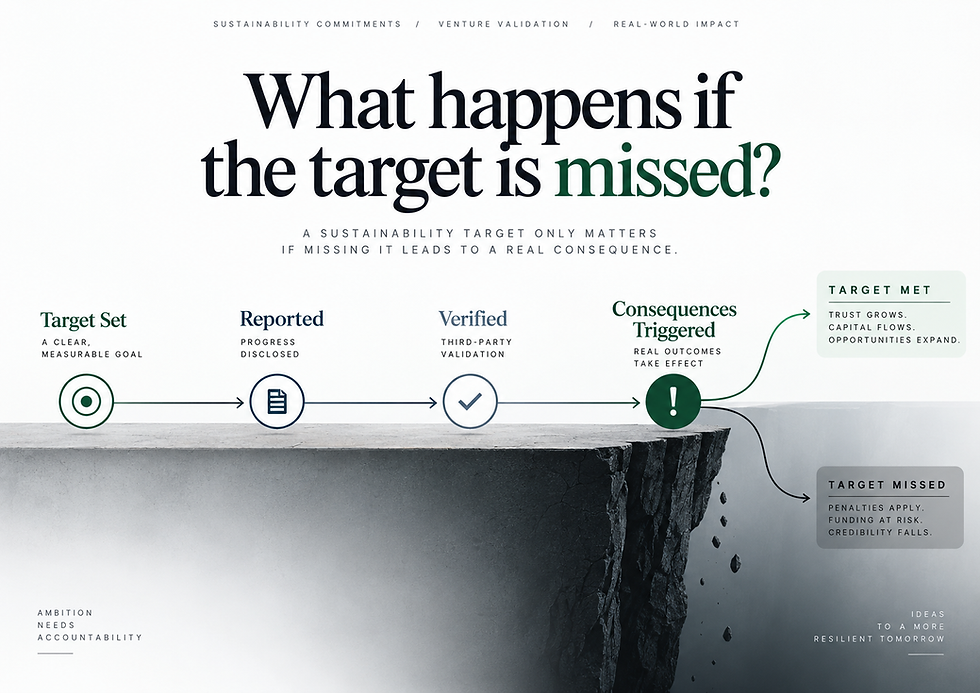
A sustainability target can be specific, measurable, and publicly reported—and still have remarkably little effect on how a business actually operates.
The simplest test is uncomfortable: what happens if the company misses it?
If the answer is “we explain the result in next year’s report,” the target may matter reputationally. It does not necessarily matter economically.
That distinction deserves more attention from companies developing sustainability-driven businesses. Innovation teams routinely validate customer demand, technology, unit economics, and regulatory feasibility. Far fewer validate whether the sustainability outcome itself is connected strongly enough to a customer, investor, supplier, or partner decision to become part of the business model.
Research on sustainability-linked bonds offers a useful clue as to why this matters.
A target is not the same thing as a commitment
Sustainability-linked bonds, or SLBs, connect financing terms to predefined sustainability performance targets. In principle, the mechanism is straightforward: achieve the target and financing continues on agreed terms; miss it and a financial consequence can be triggered.
But the important part is not the existence of the target. It is the architecture around it.
The study Binding Commitments and Credit Spreads in Sustainability-Linked Bonds, covering 915 SLBs issued between 2019 and 2025, distinguishes between target precision and contractual enforceability.
That distinction matters.
A company can announce a highly quantitative target while retaining substantial discretion over how performance is reported, verified, or treated when results fall short. Conversely, a target becomes harder to ignore when reporting is mandatory, external assurance is required, and missing it triggers a predefined consequence.

The market appears to recognize at least part of that difference.
In the study, 98.1% of the bonds included a penalty mechanism, 94.5% imposed reporting obligations, and 93.8% required external assurance. Ninety-two percent contained all three. These provisions have become close to baseline market practice.
Yet the sustainability-linked label itself did not automatically produce cheaper financing.
The more interesting finding was that stronger enforceability was directionally associated with lower spreads relative to conventional debt from the same issuer or parent. Under the strictest comparisons, however, the estimated effect narrowed to roughly one or two basis points, and the authors do not claim a causal relationship.
So the lesson is not that companies can engineer cheaper capital simply by writing stricter sustainability clauses.
The more useful lesson is that markets distinguish between a sustainability promise and the institutional machinery that makes the promise costly to ignore.
This is a venture-design problem, too
That insight extends well beyond bonds.
Consider a company building a new business around lower-carbon logistics, regenerative agriculture, industrial efficiency, circular materials, or climate adaptation.
The team may be able to quantify the environmental benefit. It may even have excellent impact metrics.
But measurement alone does not create a business.
The more important question is whether another actor makes a different economic decision because that performance exists.
Will a customer pay more?
Will a corporate buyer award a contract?
Will a bank change financing conditions?
Will an insurer change pricing?
Will a government program release funding?
Will a supplier gain preferred status?

If verified sustainability performance changes none of these decisions, the impact proposition may remain peripheral to the economics of the venture.
That does not make the impact unimportant. It means the company has not yet demonstrated that impact and commercial value reinforce each other.
This is where sustainability ventures often deserve another layer of validation.
Instead of asking only, “Can we measure the outcome?” teams should ask:
Can an external stakeholder observe the outcome, trust how it was determined, and make a materially different decision because of it?
That is a much tougher test—and a much more useful one.
Credibility should be designed early
Another finding in the SLB research is equally instructive.
Individual sustainability disclosures generated relatively limited and inconsistent repricing. One interpretation is that investors may treat enforceability as a standing property of the instrument rather than repeatedly deciding after every disclosure whether the commitment deserves to be believed.
For innovation teams, the implication is important: credibility is difficult to bolt on later.
If a new venture eventually depends on verified sustainability performance, the necessary architecture should be tested early—data access, baselines, measurement frequency, independent verification, ownership of the data, and what contractual or financial event the result triggers.
Otherwise, a team can spend years proving that its technology works while discovering much later that no one has a sufficiently trusted mechanism for acting on the sustainability outcome.
That is not primarily an ESG problem. It is a business-model problem.
The next opportunity may be commitment infrastructure
There is also a new-business opportunity hiding inside this shift.
As sustainability targets become more common, basic dashboards and reporting tools become less differentiated. The harder problem is making sustainability performance usable inside transactions.
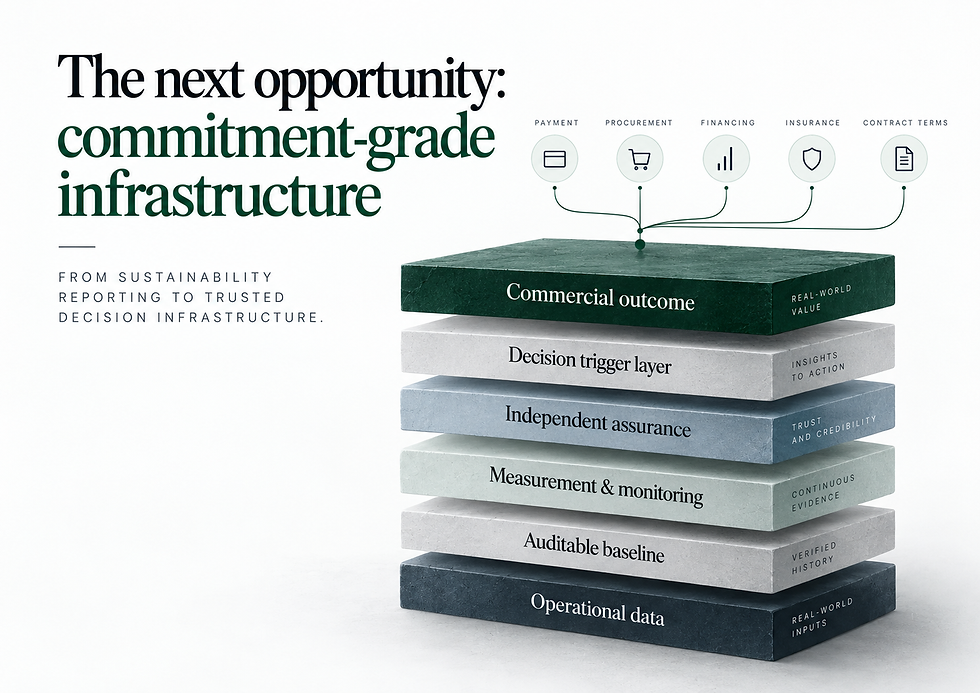
That creates room for what could be called commitment-grade infrastructure: systems that connect operational data to auditable baselines, independent assurance, and ultimately to payments, procurement, financing terms, insurance, or other commercial decisions.
The strongest businesses in this category may not sell “sustainability reporting” at all.
They may sell trusted decision infrastructure.
For executives considering a sustainability-driven venture, the question before major resource allocation should therefore be simple:
If this initiative misses its sustainability target, what economically meaningful decision changes—and can an independent party verify why?
If there is no convincing answer yet, the next step may not be scaling.
It may be validation.


Comments